

Water seepage in Hong Kong: how the Joint Office process works, and where a surveyor fits
The Joint Office investigates seepage between flats, but the process is slow and narrower than most expect. Knowing what it will not establish decides whether to wait or instruct privately.
Water seepage is one of the most common building complaints in Hong Kong and one of the hardest to resolve, because the water rarely enters where it appears.
What the Joint Office does
The Joint Office, run jointly by the Food and Environmental Hygiene Department and the Buildings Department, investigates seepage complaints between premises. Its investigation is staged: an initial inspection to confirm the seepage, then tests intended to identify the source, then action against the party responsible where the source is established and the seepage constitutes a nuisance.
Two things follow from that framing. It is a nuisance-led process, not a repair service. And it needs to establish a source before it can act.
Why it takes as long as it does
Testing needs access to the flat above, or beside, or both — and access has to be arranged rather than assumed. Some tests take time to produce a result because they rely on observing whether staining changes over a period. If the first suspected source is ruled out, the sequence restarts with the next.
None of that is avoidable, and it is why a complaint can run for months without anyone behaving unreasonably.
What it will not establish
It is looking for the source of a specific seepage between specific premises. It is not producing a condition assessment of the building, and it will not tell an Owners' Corporation whether the same defect is affecting other flats, whether the external wall is the route, or what the repair should be.
That gap is where most disputes actually sit — particularly where the water is entering through common parts, in which case the responsible party is the Owners' Corporation and the question becomes a maintenance decision rather than a dispute between neighbours.
Where a private survey helps
A surveyor can be instructed at any point, and the useful case is usually one of two. Either the seepage is suspected to come through the façade or roof rather than the flat above, in which case the building needs examining rather than the neighbour. Or the Joint Office has closed a case without identifying a source, and the seepage continues.
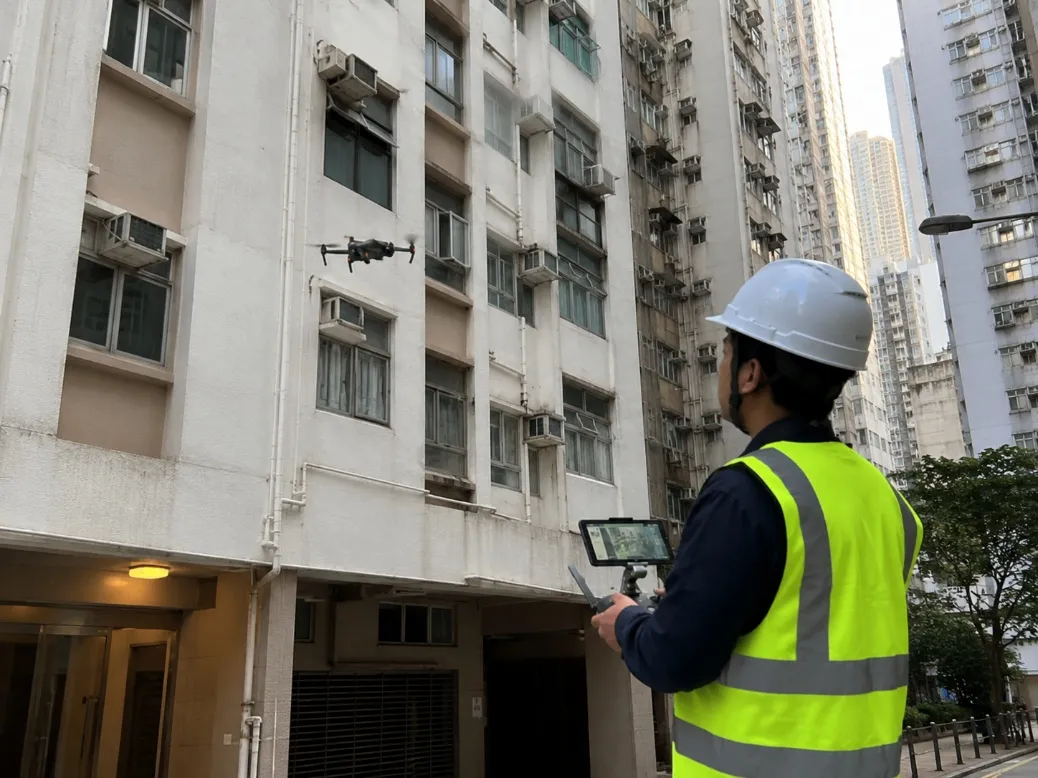
Both are investigations of the building fabric. Infrared thermography is used here because damp material holds heat differently from dry material around it, which can show the extent of a wet area that is invisible to the eye — though it shows where water is, not where it came from. That is still established by inspection.
Opulence Management investigates seepage as part of building surveying, including cases already through the Joint Office.